

Report: Why developers use LLMs to write blog posts
Results from a frustration-born survey
After hitting a few too many AI-scented tech blogs, “Why are people doing this?!?” popped into my head. First, it was really just a cry of frustration. But then it shifted into a more curious “Why ARE people doing this?”
Since I already understand the “write your own words” POV (plus, there are many fantastic articles from this perspective1), I wanted to better understand the other side. Who is using LLMs to generate drafts and why/how are they doing it?
To explore, I shared a quick anonymous survey on X, Bluesky, LinkedIn, Mastodon, and a few developer Discord servers. 181 people responded. The sample is relatively small and self-selected, so please consider the results to be a snapshot rather than some sweeping generalization of the entire dev community.
This article shares what I felt were the most interesting findings, including:
40% of “always-LLM” writers never wrote before, 20% rarely wrote before
72% of those who generated LLM drafts performed substantial editing, 23% totally rewrote the drafts
Only 13% felt LLMs captured their voice, only 11% felt LLMs captured their ideas
73% did not disclose that they used LLMs to write2
Note: Some rather passionate free-form responses inspired me to run a second survey. That one focused on how readers react to AI-scented tech blogs and how the writer’s language background factors in. Stay tuned for those results. [Update: here you go]
Writing motivations and experience mapped to LLM writing propensity
I wanted to group respondents by “propensity to LLM writing” and look for patterns across groups. So, the first question asked whether respondents always, often, occasionally, or never use an LLM to draft their blog posts.
The sharpest differences surfaced around:
Their previous writing frequency
Why they use LLMs to draft articles
Their top motivation for writing
Here’s the overall breakdown for each of those…
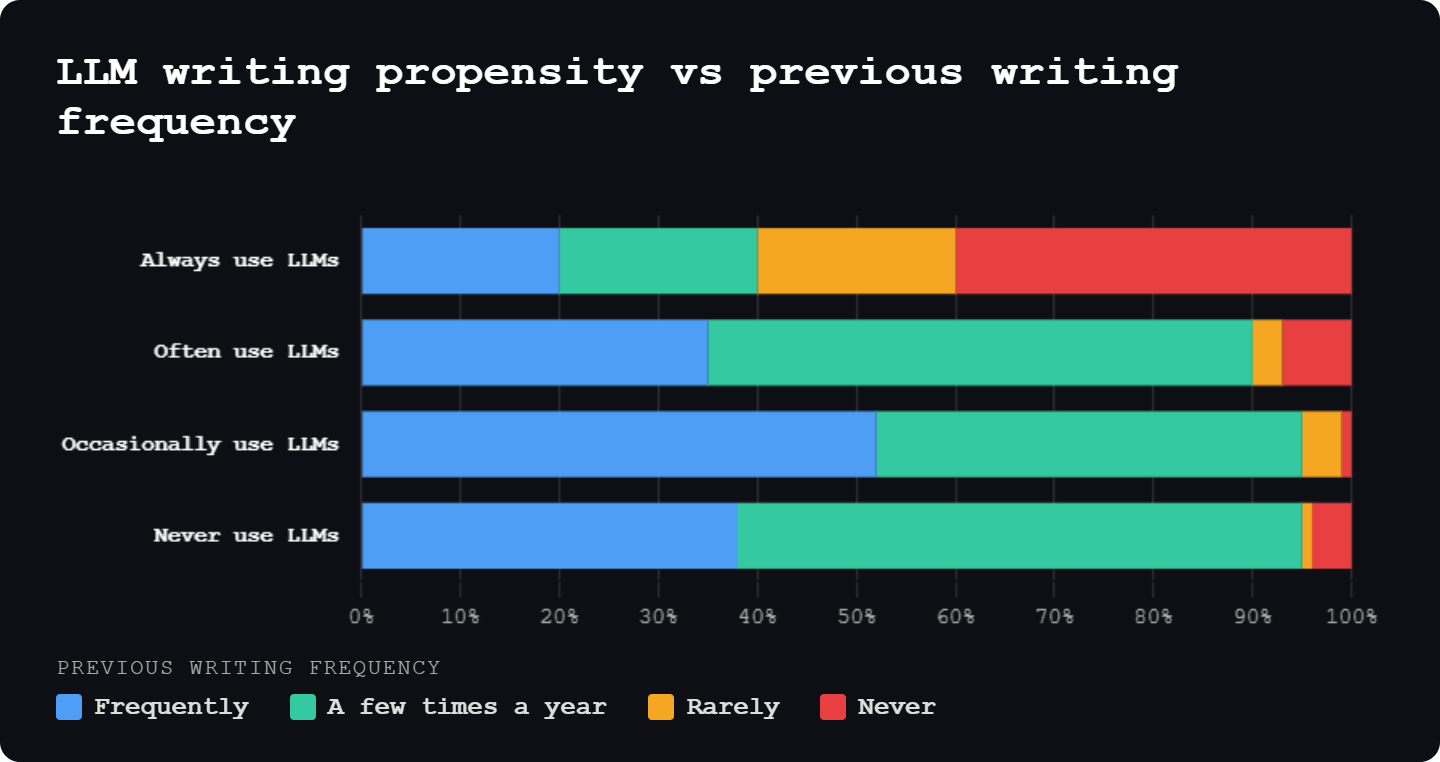
How previous writing frequency maps to the likelihood of LLM writing
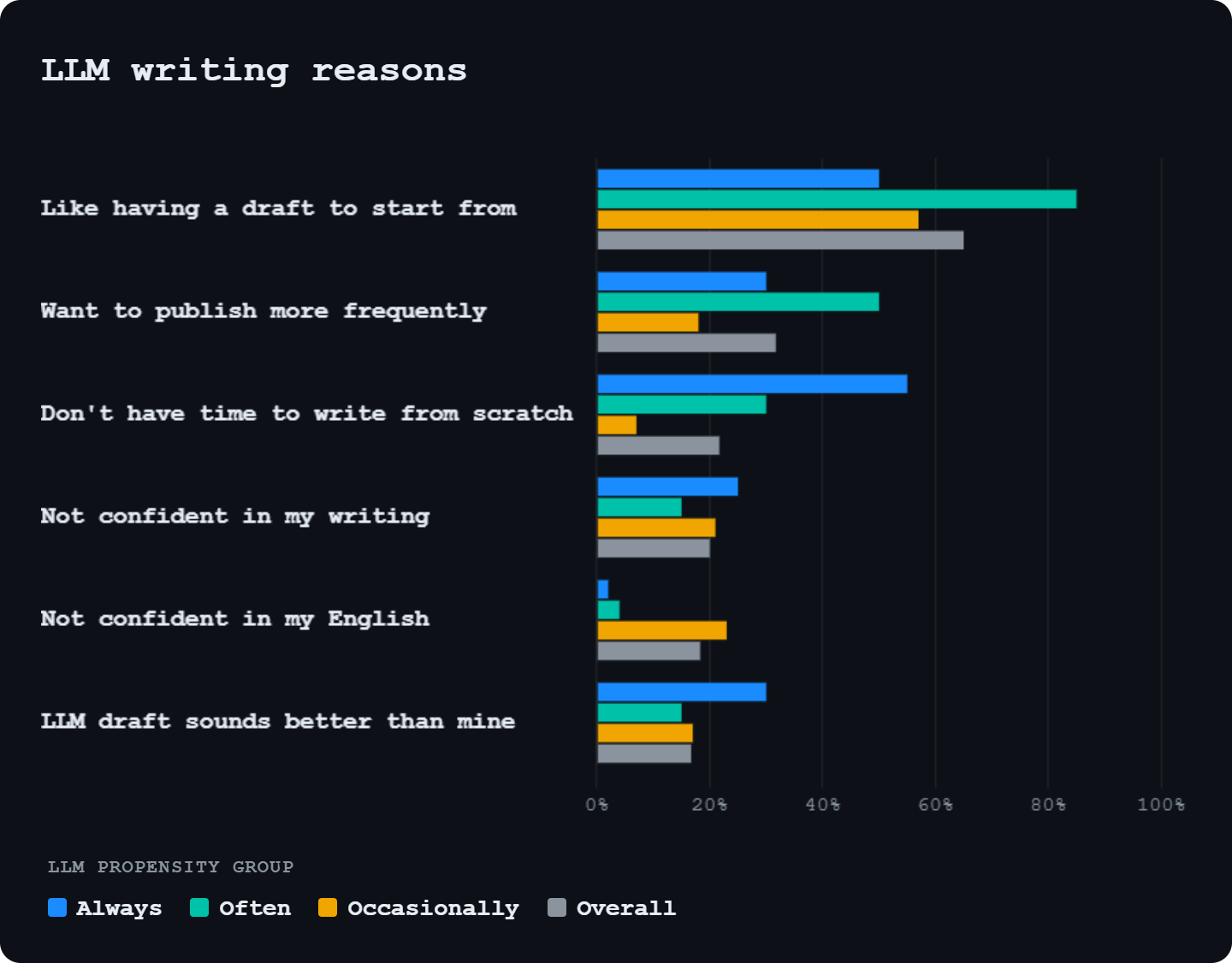
How the reasons for writing with LLMs vary across LLM propensity groups; respondents could select multiple reasons
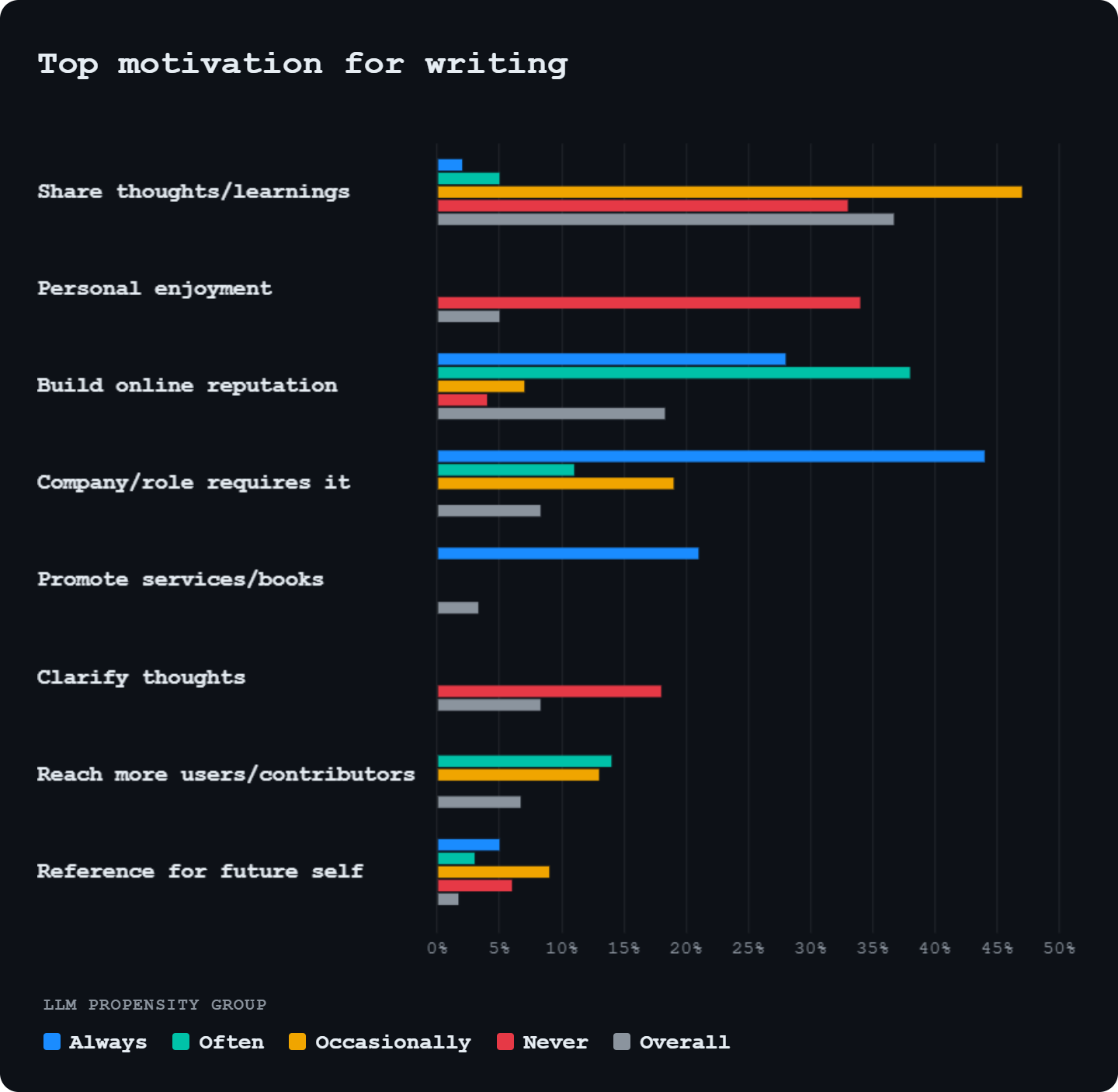
How top writing motivations vary across LLM propensity groups; respondents could select only one option
Also, here’s a look at the context each group provided. Nothing too surprising here, but it’s still interesting to see what people are using.
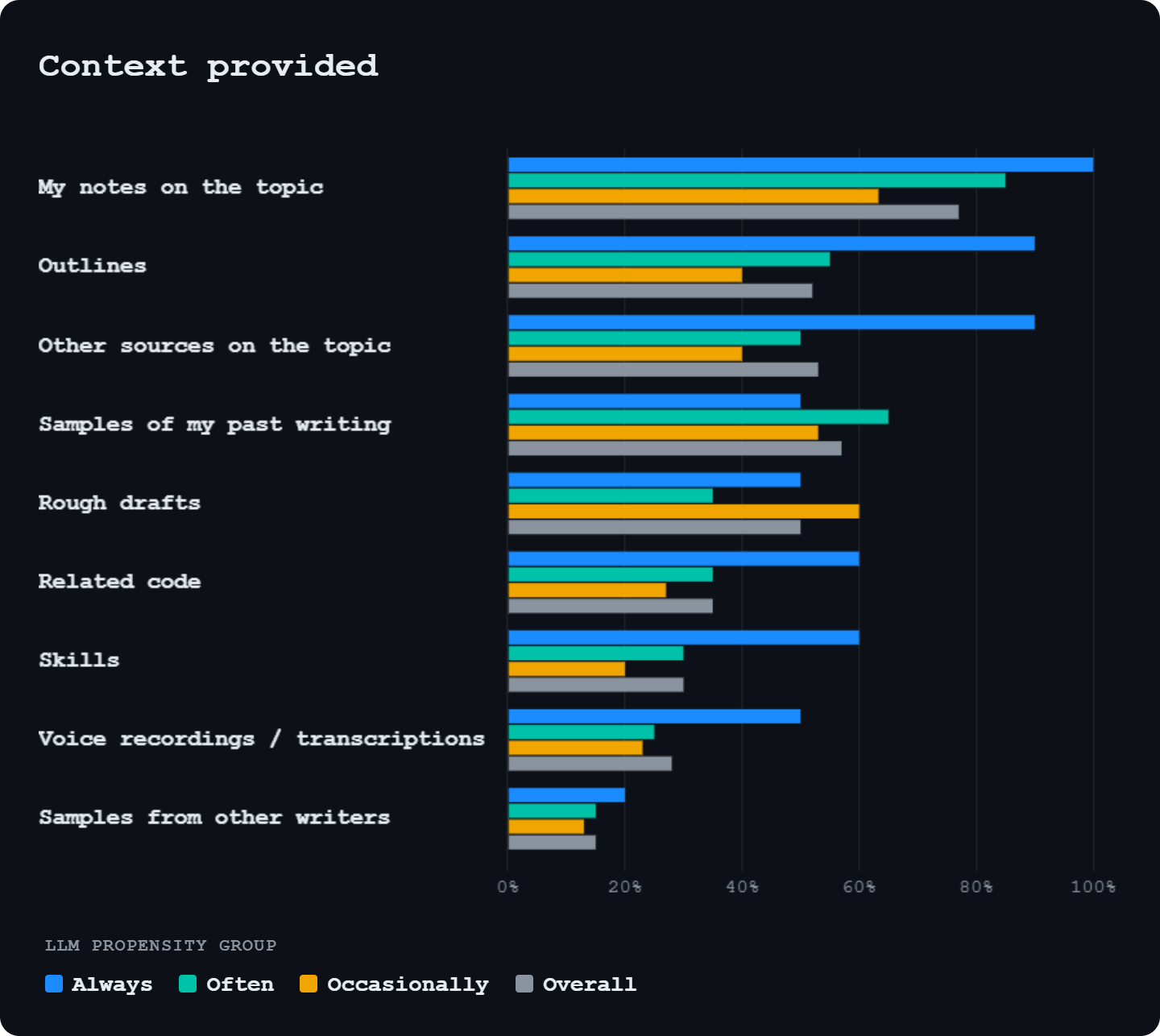
How the context provided varied across LLM propensity groups; respondents could select multiple options
Here’s a closer look at each group…
The “Always” group: novice writers, obligatory writing
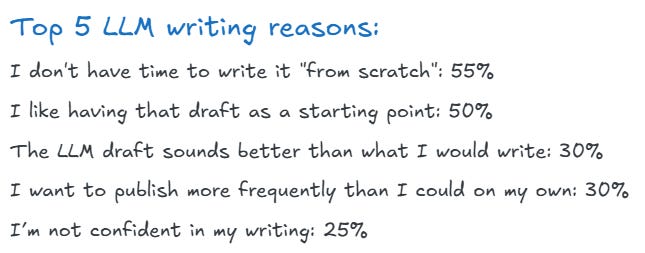
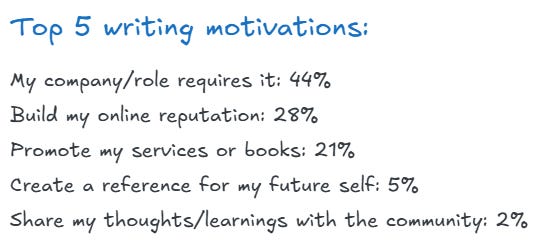
The “Always” group had the highest concentration of inexperienced writers. 40% reported they had never written blog posts previously, and another 20% said they wrote only rarely (twice a year or less).
Respondents in this group tended to write for their job and/or for personal/professional promotion. It was the only group where “I don’t have time to write it from scratch” emerged as the top reason for using LLM drafts. Many expressed insecurity about their own writing and felt the LLM drafts sounded better than what they could create.
The “Often” group: more drafts for more attention
As shown in the earlier chart, the “Often,” “Occasionally,” and “Never” LLM writing groups included much more experienced writers than the “Always” group. In those three groups, 90% or more previously wrote at least a few times a year.
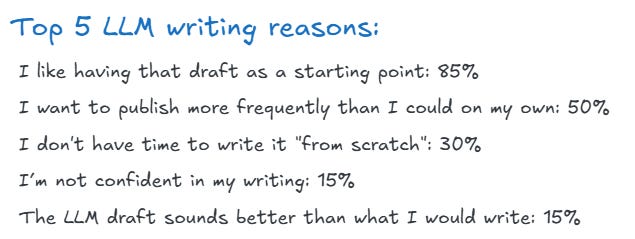
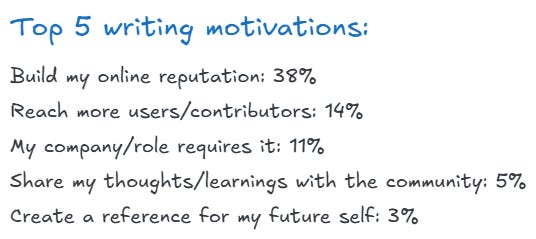
The “Often” group skewed toward writing for attention – for themselves and their projects. And they were more likely than other groups to cite increasing their publication cadence as a reason to have LLMs draft articles for them. Like the “Occasionally” group and the overall average, their top reason for LLM writing was that they liked having the draft as a starting point.
The “Occasionally” group: it depends
The people in this group also reported solid writing experience. They weren’t opposed to using LLMs for writing, but it wasn’t their default. Most were writing for the community, some were writing for their company, and a smaller subset were writing for themselves.
This was the only group where both English barriers and writing barriers appeared among the top five reasons for using LLMs.
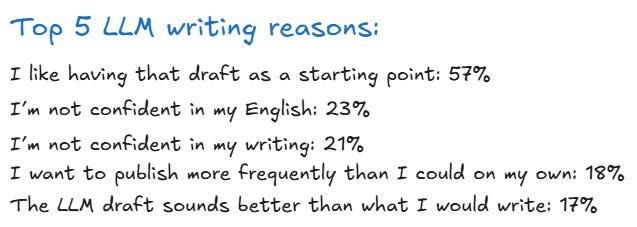
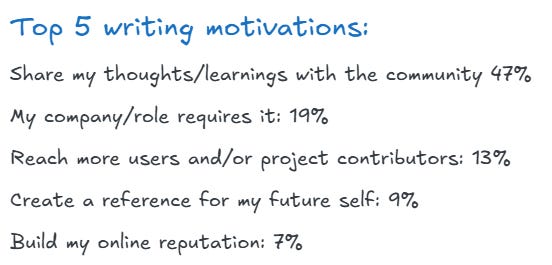
Some of the write-in responses shed light on when members of the “Occasionally” group flip to LLM writing:
“I have two writing ‘personas’: one for work and one for my own media outlets. I use LLMs more for my ‘work’ persona because it is better at corporate style content. For personal use, I only let it proofread my text and provide suggestions for specific cases (e.g., help with an expression).”
“I mostly use AI to produce writing I know no one will read, but am required to write and am not given time to write to my own standard.”
The “Never” group: no thanks, writing matters
This group includes:
Those who never tried LLMs for writing, and
Those who played around a little, but never published the LLM drafts
Many write for the sake of writing: 34% because they enjoy writing and 18% because writing helps them clarify their thinking.
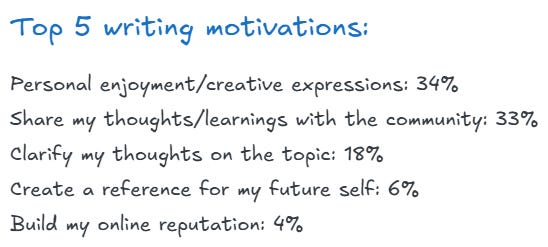
“Writing as thinking” is a prevalent ethos among experienced tech bloggers. As Charity Majors strikingly put it:
“Writing forces you to hold your beliefs up to the light of day and examine them for inconsistencies, lack of evidence, shoddy logic, or even just non-compelling arguments. I was just realizing recently how much my writing has shaped my convictions, at least as much as my convictions have shaped my writing.”
When writers value the friction of the writing process itself, outsourcing the drafting component translates to fulfillment lost, not time gained.
Although this group selected “not applicable” for LLM writing reasons, they certainly weren’t shy about sharing their thoughts on writing with LLMs. See the end of this article for their commentary.
Extensive revision was common – even for frequent LLM users, even with a rough draft provided
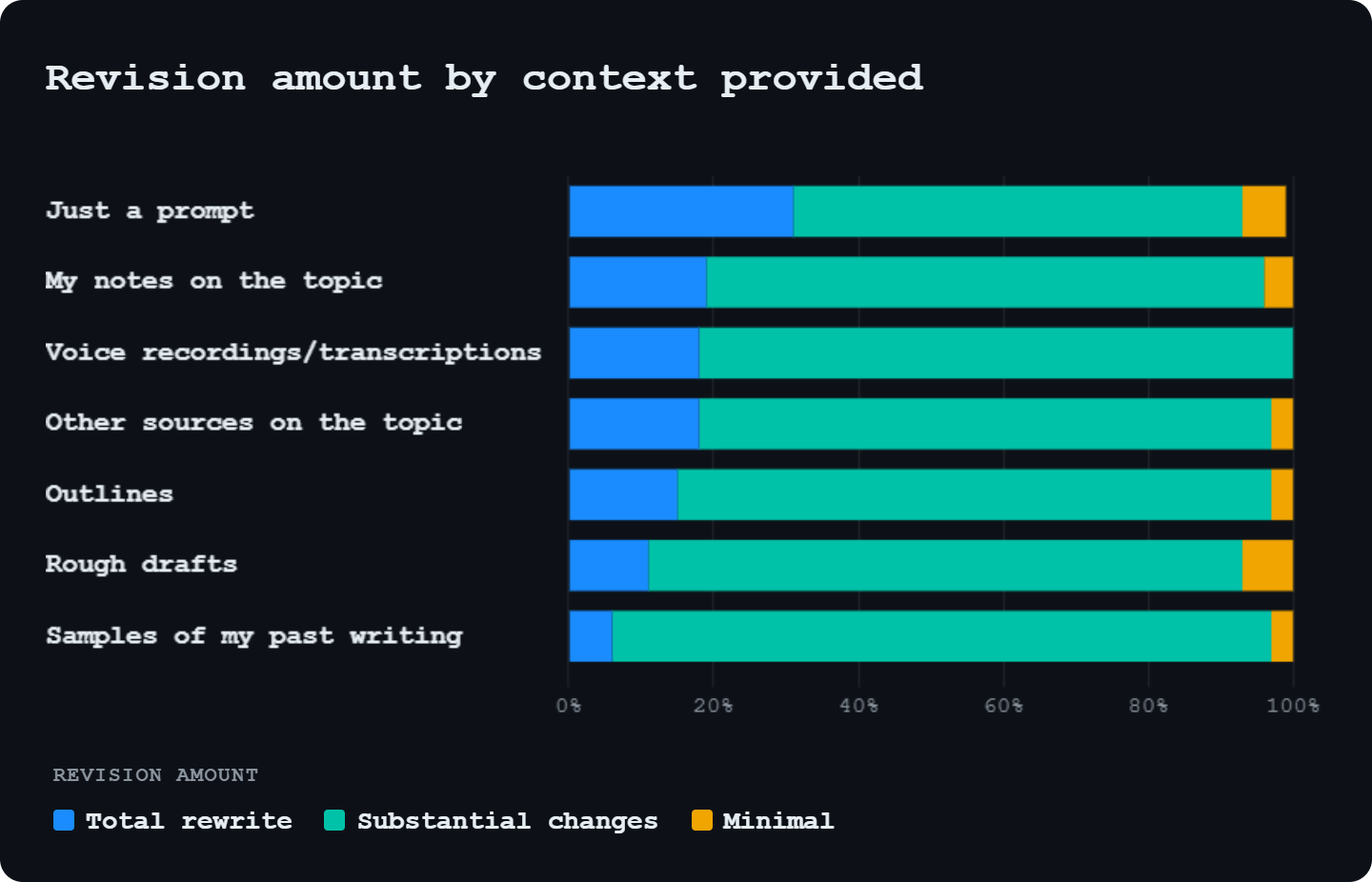
72% of those who generated LLM drafts performed substantial editing (adjusted positioning, tightened technical accuracy, adjusted the tone, removed generic parts…). 23% totally rewrote the drafts.
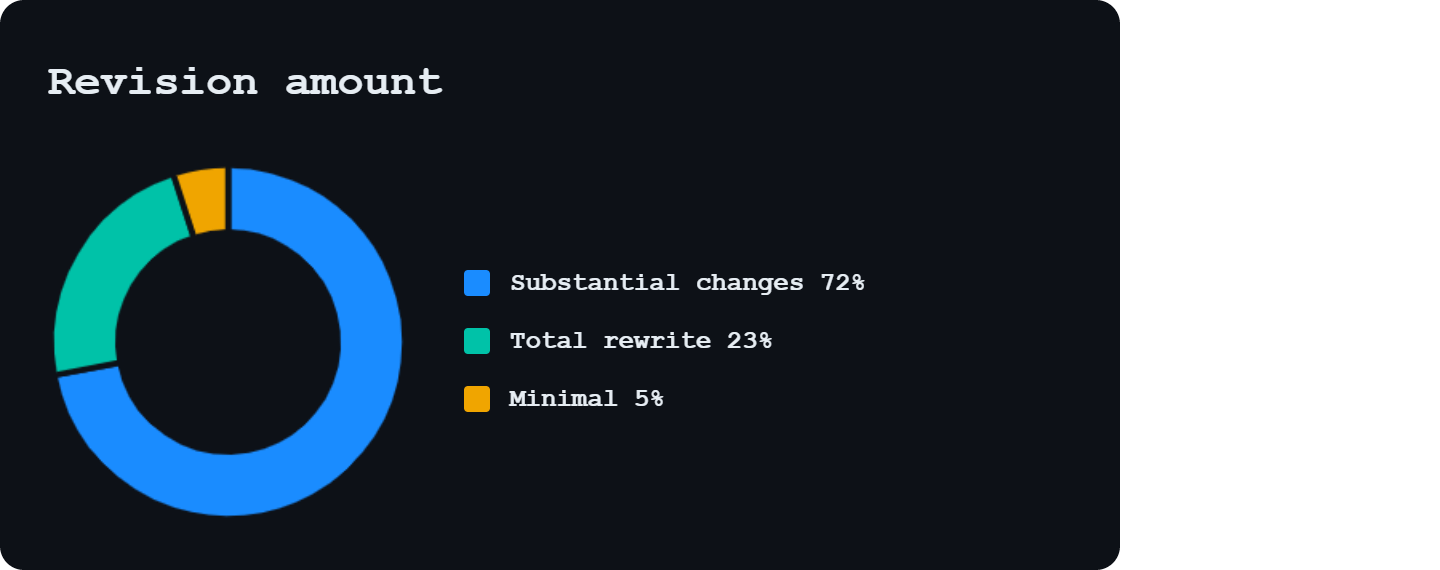
Even when the author’s own draft was provided as context, 11% totally rewrote the initial LLM draft and 85% made substantial changes to it. This makes you wonder: what is the LLM doing to that original draft?
Capturing the writer’s voice was hard
Possibly one factor behind the extensive revision… only 13% of those using LLM writing reported that the generated drafts sound like them.
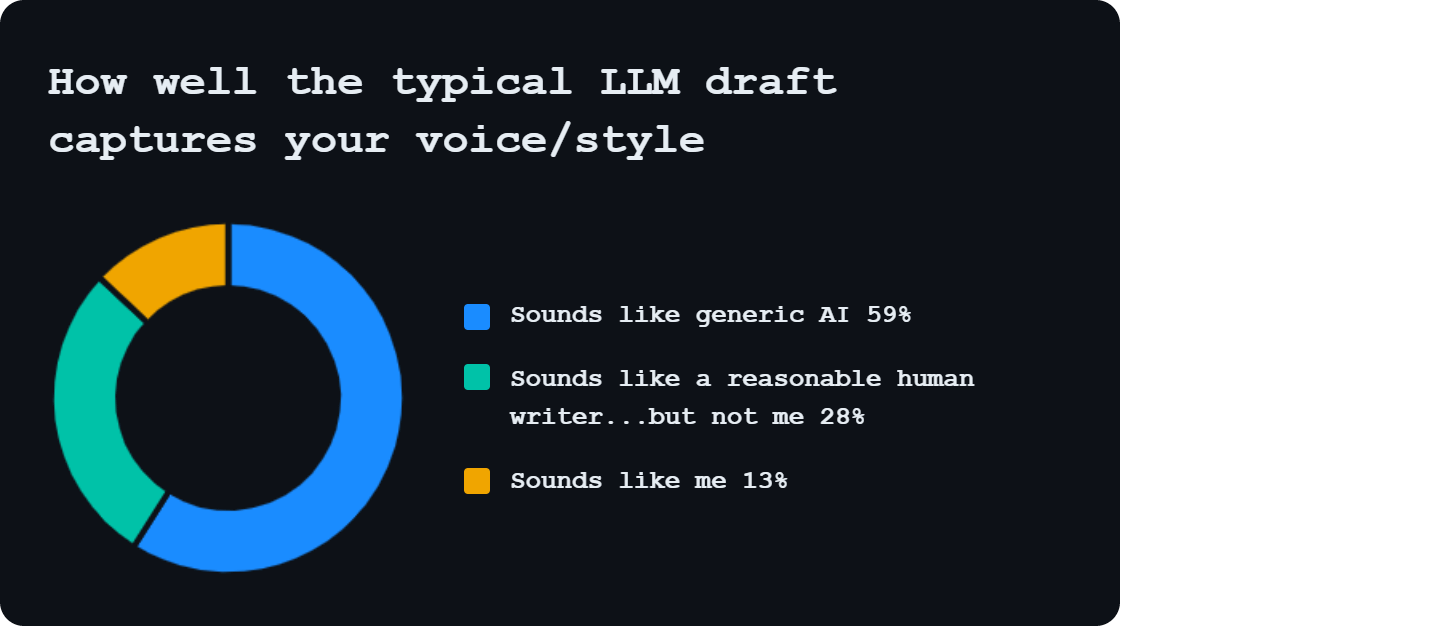
Even among the small “Sounds like me” group, 66% still performed substantial revision.
The data suggests a correlation between the depth of context provided and the LLM’s ability to mimic the author’s voice. With high context (e.g., their own drafts or voice recordings/transcriptions), the “sounds like me” percentage increased to 18%. Among those who fed the LLM their own draft as context, 24% reported it “sounds like me.” So yes, it helps… but you would think that having a draft written by the actual author would help a bit more.
Capturing the writer’s thoughts was even harder
LLMs were slightly worse at capturing the writer’s thoughts. While 13% of the LLM writers said the LLM drafts captured their voice, only 11% felt the drafts captured their thinking.
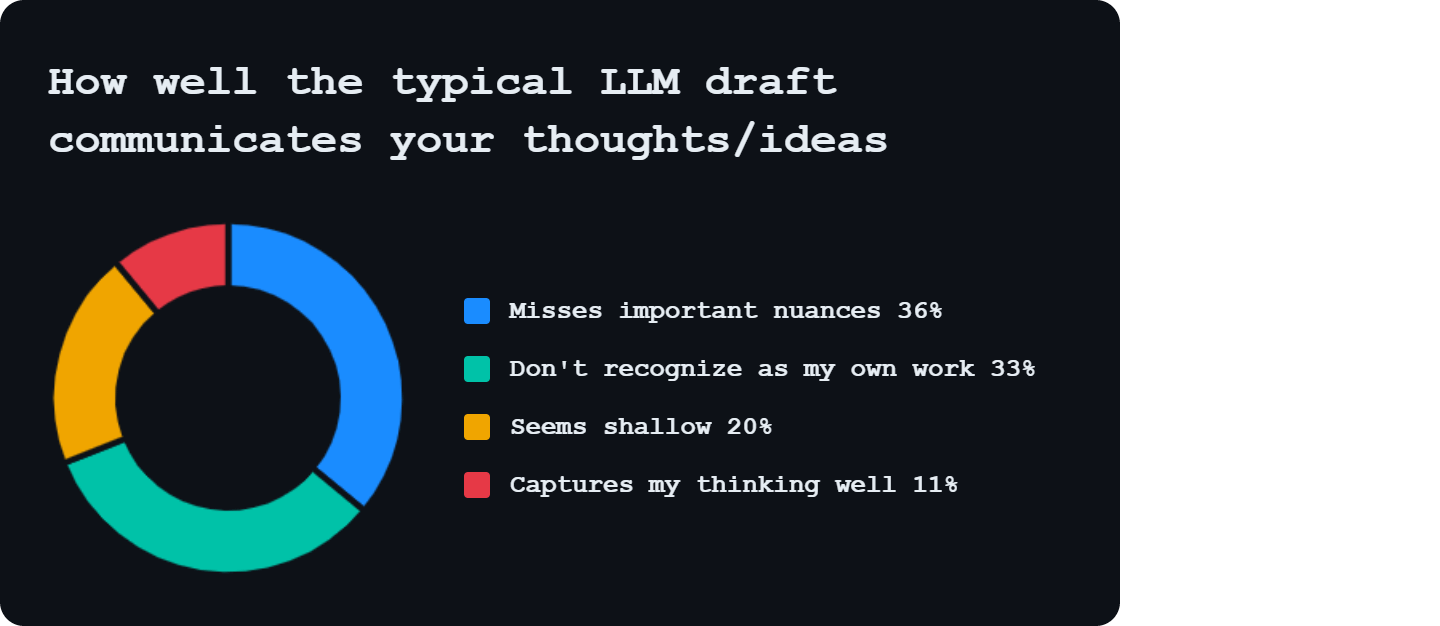
Among the small “Captures my thinking well” group, 80% still performed substantial revisions.
Again, more/better context seems to help, but not much. 15% of those who provided high context (e.g., their own drafts or voice recordings/transcriptions) said that it “captures my thinking well.” Among those who provided their own rough draft as context, 18% said the LLM draft captured their thinking well.
LLM use was rarely disclosed
Only about a quarter (27%) disclosed their LLM use when publishing.
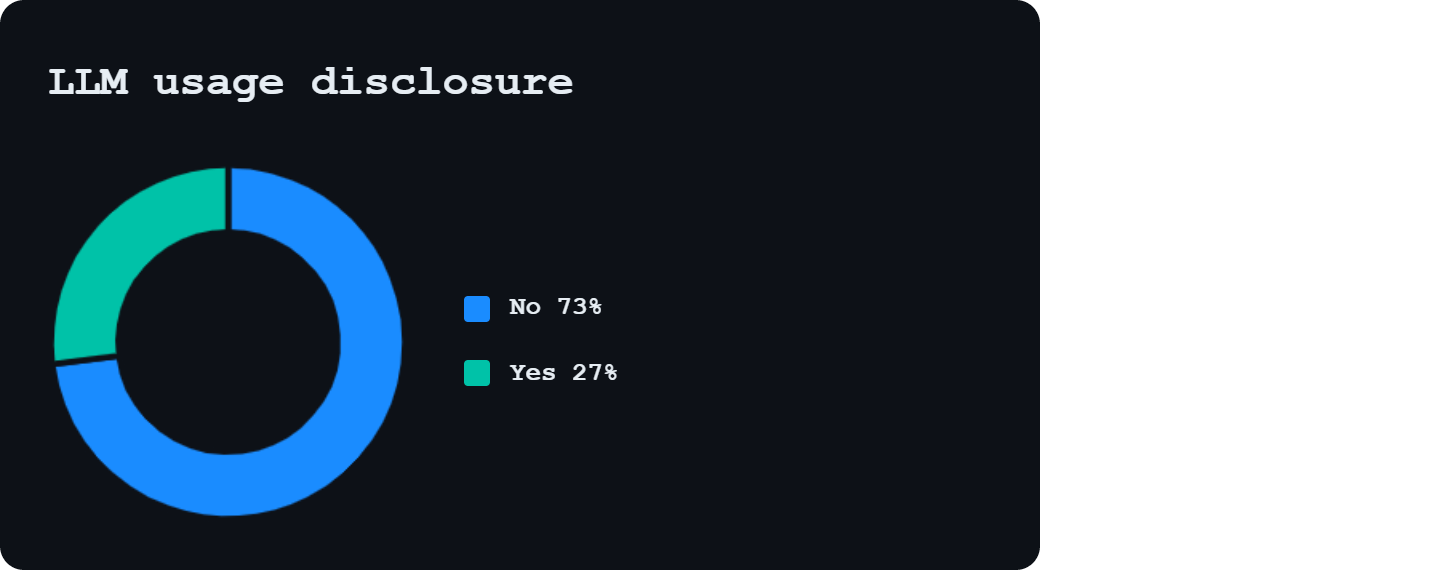
Non-native English speakers who published LLM-drafted content were more likely to be open about it. 33% of non-native speakers disclosed their LLM use (vs. 21% of native English speakers).
On the other side of the spectrum, some respondents who never use LLMs for the actual writing noted that they provide different disclosures. They tell readers exactly how they do – and don’t – use AI throughout the blog creation/publishing process. Here are a few examples of what such disclosures look like in practice: Gunnar Morling | Robin Moffatt | Cassidy Williams.
And all these answers lead to… more questions
That was a lot, but there’s still more to explore. Two of the areas I’m particularly curious about are LLM writing triggers and revision nuances.
For those who use LLMs as the exception rather than the rule, what triggers them to shift into LLM writing mode? Being pushed to write something that’s not meaningful to them? Uncertainty about how to approach that kind of article? Difficulty untangling their thoughts on the topic? Other friction points?
The high amount of revision being reported is also quite intriguing. Are people revising so that the LLM draft better reflects their ideas and voice? Or is the revision primarily to wipe out AI tropes (and avoid being AI-shamed)? Do some developers actually prefer optimizing/debugging LLM articles to creating their own? It would also be interesting to see how much time is spent editing LLM-generated articles and compare the total “start to finish” time versus hand-crafted articles. And how does the technical depth and readability of a generated-then-heavily-revised article compare to that of a purely human one?
So much more to explore, and more to write. Thanks for reading this far. Please share your thoughts, theories, experiences… Also, stay tuned for a report on what specific actions people take when they hit an AI-scented tech blog.
Selected responses
Given the topic, it seems appropriate to end with additional human voices. Here are some of the comments that people shared, verbatim.
Why they avoid LLM writing
“I wouldn’t ever expect to get something out of an LLM as a draft that was worth reading, so I haven’t bothered. If I can’t be bothered to think about something deeply enough to bang out a draft, an LLM isn’t suddenly going to make that a valuable exercise.”
“I love doing research and hate writing about it. The idea of having an LLM take care of the excruciating part of the work for me does have some appeal but I could never be proud of an article, presentation, or video that I didn’t make myself. Additionally, I have no desire to consume any media that is AI generated (or “heavily assisted” by AI), so I’ve decided not to produce it either.”
“People have always liked my writing, especially my technical explanations. Why would I want to make it wordier, less clear and more generic?”
“The number of people using LLM to draft is quickly dwindling as people learn to recognize slop or slop-based writing and it backfires on the writers. I keep experimenting with LLM as a style check or finding holes in my arguments, but keep finding that the LLMs aren’t good at it. Coming from a publishing background, this doesn’t surprise me. Whenever an expert checks the quality of LLM-generated text in his domain, the results are usually disastrous. Excellently drives the point home that LLMs don’t “analyse”, “think” or “understand” anything. They ‘just’ try to generate the perfect response, or hand over the prompt to some specialized model (not necessarily a LLM).”
“I didn’t spend 30 years learning how to write well to have a machine barf out lowest common denominator text for me. And that’s not even counting the significant moral and ethical issues with them, or the cost (which will go up a lot). I’m cool with keeping and developing my own skills.”
Tried it, didn’t like it
“My experiments with LLM generation have shown me that it’s a fast way to produce something that isn’t worth my time to edit. Far better to put in the effort to refine the idea myself, and I’ll remember it better afterward, too.”
“I write about 60% to clarify my own thinking, 25% to share with the community, and 15% to help my future self retain things. I thought LLM assistance might help with that second 40%, but I found the voice to be so deficient that I discarded the couple of drafts where I tried that without publishing them anywhere. For other than very barebones, step-by-step instructional style writing, these tools are not fit for purpose. The starting points they offer me, if I try to use them that way, take me longer to massage into a reasonable piece than it takes starting from a blank page.”
“I used LLMs to help write a couple articles, and really gave them control over some of the voice, but these articles got absolutely slammed on HN. Even though it was my observation, LLM structure and tendencies get picked up quickly, and downvoted heavily. For my last few articles, I use LLMs closer to an aid for my writing. I might use the LLM to analyze something technical (like get me references to what a PR changes, or ask it describe a code snippet. I write the article, it’s in my voice, and I mostly use AI for critiques like ‘how can I make this better,’ or ‘what am I failing to explain.’”
“I tried getting research mode Claude to generate posts on topics I had planned, to see if it could cut down a lot of the research and drafting time. It... kind of worked, in that mass agent swarm research produced good leads, but the end result was both verbose and lacked depth.”
Why they use LLM writing
“Sometimes, when I’m still formulating my thoughts, I find it hard to express the point I want to make and be concise at the same time. So I will just write a stream of consciousness ramble, and then ask AI to “make this simpler, clearer, and much more concise.” That usually removes the redundancy and puts things in the right order, giving me something to work from. So, basically, Clippy 2.0.”
“I consistently struggle to share what I work on when I am in the midst of it, and have tried to avoid this constraint by having the LLM help me express ‘something rather than nothing.’ Nevertheless, the best writing is still when I essentially do an entire rewrite, and there are also times when I write about one direction extensively and then change direction so the writing becomes useless, but the opportunity cost is much lower than had I done it all from scratch. That said, I do not publish things which are schlock, and am surprised at the lower standards of many others using LLMs.”
“The most important contribution from the LLM is helping me actually being able to release what I write. I never publish raw, because I feel strongly that there’s no point in publishing if I don’t write it myself. But it helps me from eternal polishing and also tightening the structure.”
“I already generate ideas independently. LLM accelerates execution.”
“I know it sounds like cheating, but writer’s block is real and LLMs have helped. I use transcription or stream of consciousness writing as the input. LLMs give structure, which I can easily hack on endlessly, giving it my own voice.”
“I found the sweet spot is getting started and to a reasonable structure with Claude, and then writing the important bits myself, instead of being bogged down with boring bits like good (not FooBar) code examples or just not finding the time/motivation to write at all. Ah, and also adversarial reading so I’m not stuck in my own view!”
“Writing good and coherent text takes lots of energy for me [a non-native English speaker]. With LLMs, it takes much less.”
Working with LLMs
“I think people use AI in writing poorly. The actual writing is terrible. I see two uses for it. One is to get unstuck. Maybe it writes something as a forcing function and then I rewrite the f*ck out of it. But it helps to have something you hate. Another much more interesting way is to use it as a text manipulation tool rather than writing. Like say this paragraph works but the argument has a structural flaw, let’s try to reinforce it by shifting tone like this but keeping in mind that other thing. Etc. Then it “writes” closer to you because it can’t do the generic AI thing. It’s engaging with *your* critique and it gets specific since you explained what you care about in writing. Then it’s a thinking tool.”
“I know I can get something ‘more useful’ out of an LLM by seeding it with my own notes etc., but I don’t see any value there. I AM interested in using an LLM to write tools to help me make sense of all my scads of notes / images / quotes saved for future writing, and to use as fuzzy search on my collection. I think it can be useful in an “admin” type way, to make the task of finding and sorting easier, and to build a custom tool I want for the way I like to work. But to actually write? Never. Every word is too important.”
“I want to get a sense of how an LLM would write about a given topic, and check that I’m not thinking about it in an ‘average’ way.”
“I use LLMs heavily in writing but I typically do this as my process now: 1) Gather a bunch of notes and do a voice transcription of my thoughts and the points I want to make 2) Use a LLM to make an outline from those that tells a cohesive narrative and supports my points 3) Draft myself from that outline 4) Use LLM for final polish/ideas on how I can make the argument stronger.”
“It’s the worst. But I find I get triggered by “entities” being wrong helps me to know how to fix it. I’ve tried writing with an LLM, where my process is: Here is my outline, here is {unique context that should teach it how to write like me}, now write an article. I’m paraphrasing, it is much much more involved with that. But the result is SOOO bad, that I’m motivated to fix it. It’s like a terrible puzzle where all the pieces are white. I like puzzles, and the output of llms are the worst.”
“I use AI extensively in the drafting phase but typically throw it all (or most) away and write the final product line-by-line by hand, then have another pass with AI to edit. I don’t really care if something is AI-assisted or drafted if it communicates the subject compellingly with a cadence and rhythm that is enjoyable to read. I’ve just found that AI doesn’t do that, which is why I often stop reading posts that are obviously AI-drafted.”
Roll the Credits
Thank you to everyone who responded, and special thanks to those who helped shape the survey in various ways: Phil Eaton, Jeff Atwood, and Tim Koopmans.
My two favorites: “Your intellectual fly is open” by Bryan Cantrill and “Why I don’t allow AI-generated content on my blog” by Sean Goedecke.
Speaking of LLM disclosures…I used LLMs to analyze the data and create the charts.
Revising to avoid sounding like AI in fear of being AI-shamed is one of those things that should not be a problem but is. Society has to stop AI shaming blindly as the fact that something was generated by AI does not mean it is bad or even incorrect. The creator could have done lots of research and proofreading, just that rewriting of not their . But on the other hand, we have no control over our critics and as long as society continues to AI shame, creators have no choice but to invest time in rewriting.
Thanks for this super-interesting write up. I know devs who only use LLMs to write, leading to AI-sounding articles, and those who don't touch it with a 10 foot stick (and still use LLM for research).
It's rare for authors to disclose how they use LLM in their writing. I am curious about that as a reader and fellow writer.
Can you share how you generated these charts? Are these custom built or is it part of existing software?