

Report: How developers react to AI-scented blog posts
98% of readers prefer imperfect-yet-authentic human writing; most will stop reading, block you, and downvote you if they suspect AI
“Wow, looks like Claude just wrote another blog post…can’t wait to read it!”
– No developer, ever
The Writing with LLMs report explored how developers – many of whom never published before – are now using LLMs to write technical blog posts. The most commonly cited reasons were to get past the blank page barrier, publish more often, and save time. That (potentially) helps the writer. But what about the reader?
While working on that writing report, I wondered what specific actions readers take when they suspect articles are LLM-authored or LLM-assisted. Do they hold their nose and continue if they sense underlying human insights? Block the domain and try to sabotage the article’s success on the aggregators? Something in between? And are they any more forgiving when it’s a non-native English speaker who uses an LLM to “polish” their prose?1
So, out went another survey. I shared this one across X, Bluesky, and LinkedIn. Lots of people feel quite passionately about this topic; I ended up with 668 responses (versus 181 for the writing survey). Note that while I targeted the survey to developers and readers of tech blogs, the survey was anonymous – so there’s no demographics guarantee.
TL;DR Readers really despise and distrust articles that seem shaped by AI. They not only stop reading, but also block and punish the author. Non-native English speakers get little mercy. Readers overwhelmingly prefer imperfect-yet-authentic writing over LLMified prose.
Readers care a lot…and will punish you to the best of their ability
The first question was “How much does it matter to you if a tech blog seems AI-assisted/AI-authored?” A lot, actually. Here’s what people reported:
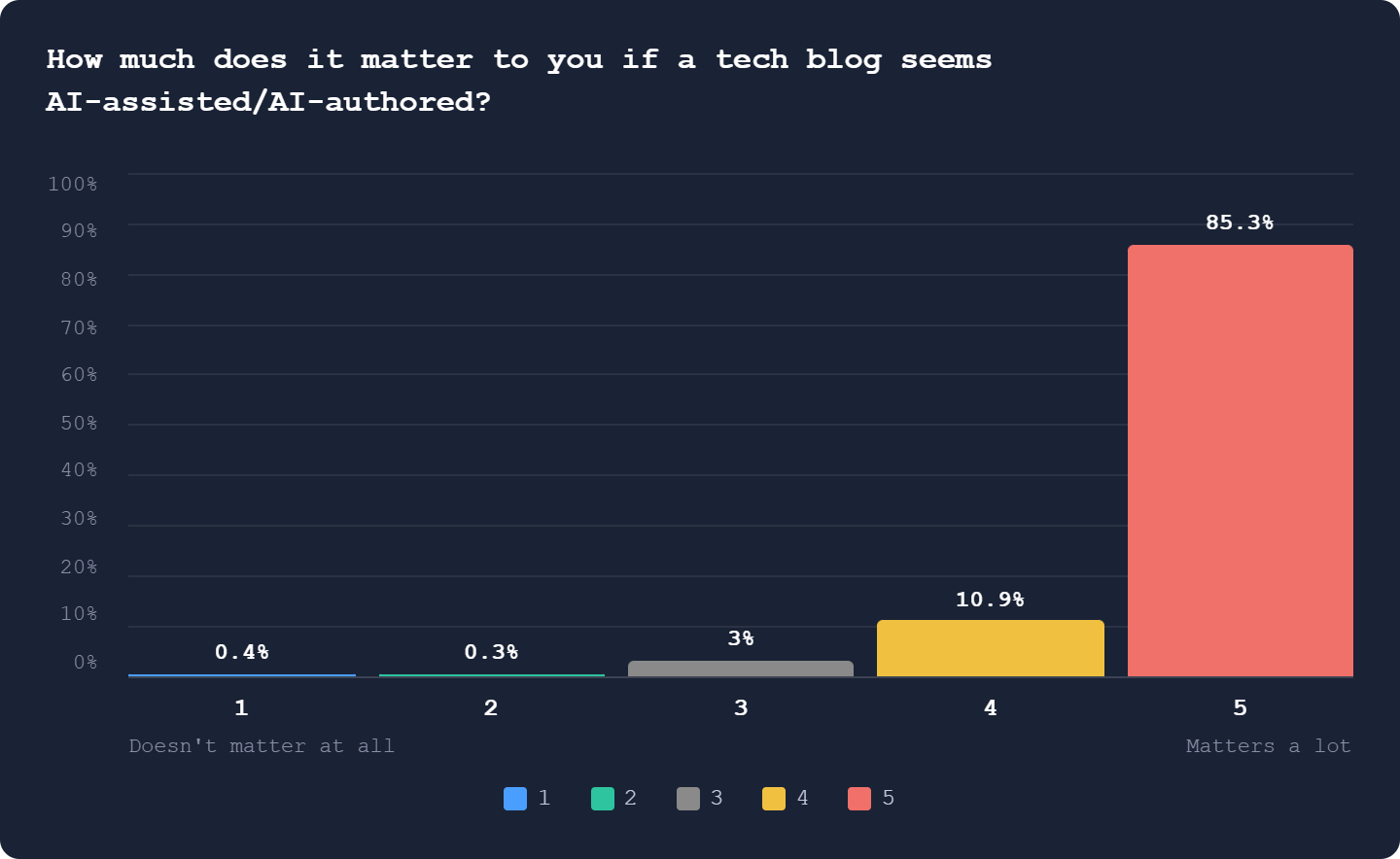
85% of respondents rated their concern a 5 out of 5, and 11% rated it a 4.
How does that concern translate to action? The next question asked, “How do you respond if you think a tech blog is AI-assisted/AI-authored?” Respondents could select multiple responses. The results:
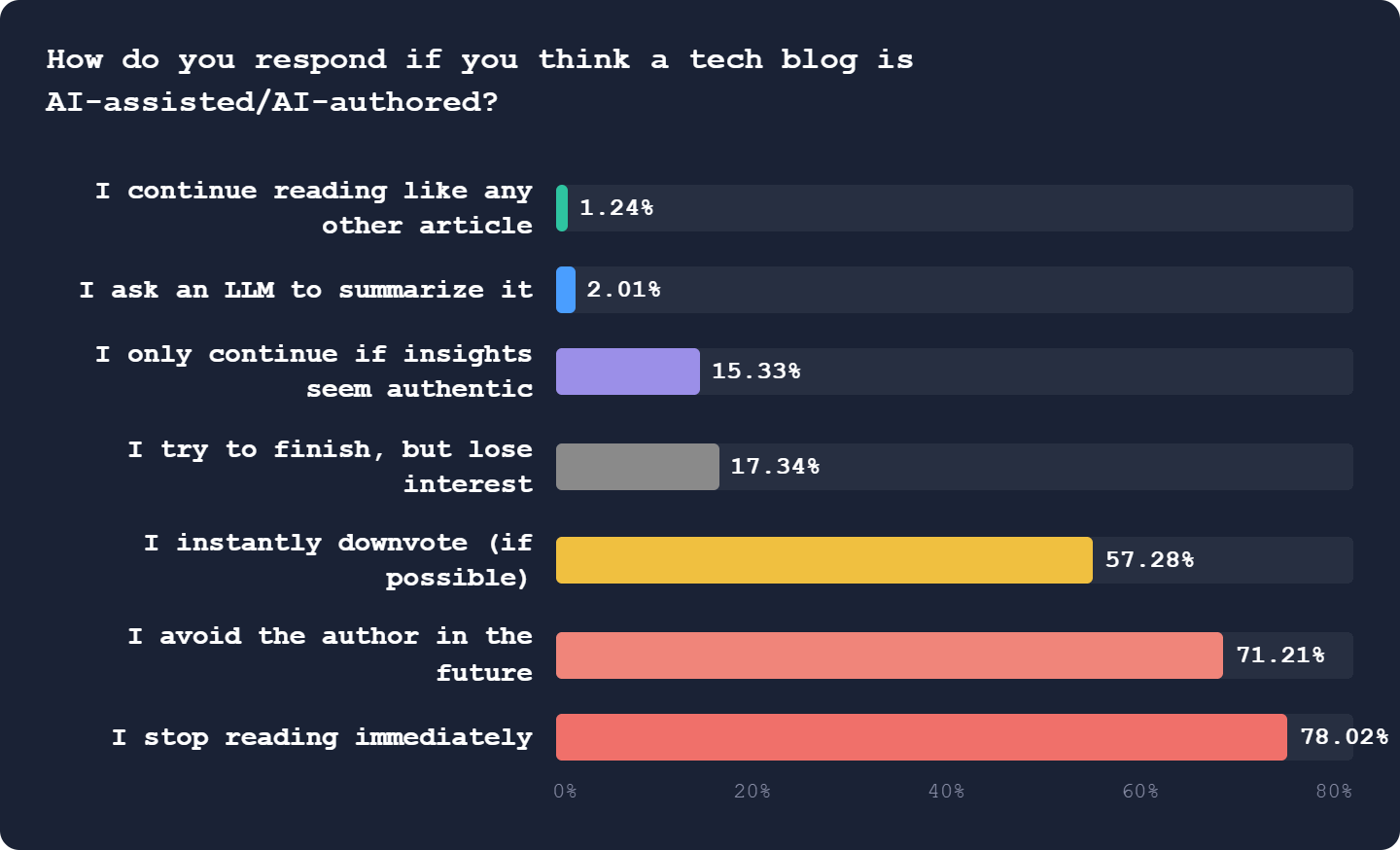
So if readers think your article is AI-assisted or AI-authored, most will immediately leave (78%), avoid you forever (71%), and try to downvote you if they can (57%). 17% try to finish but lose interest, and around 15% will only continue if the underlying insights seem authentic.
And that brings up an interesting point. There are a lot of different ways that a tech blog might end up feeling AI-assisted/AI-authored:
A non-native English speaker writes a complete draft, then hands it to an LLM to “polish my English”
A novice writer isn’t sure how to get started, so they collect their notes, voice recordings, PRs, etc. and ask the LLM to “make this into an engineering blog post”
An aspiring influencer is trying to get attention, so they ask the LLM to write an article on some trendy topic and publish the response
All might end up with the same LLM writing tropes, even though the amount of thought behind them is certainly not equal. But readers generally don’t differentiate in their reactions. They distrust the article, instinctively.
Does English mastery matter?
That leads to the second part of the survey, which looked at whether the author’s English mastery mattered.
Would readers be more forgiving if they knew the author was a non-native English speaker writing their own thoughts but using AI for translation or language assistance?
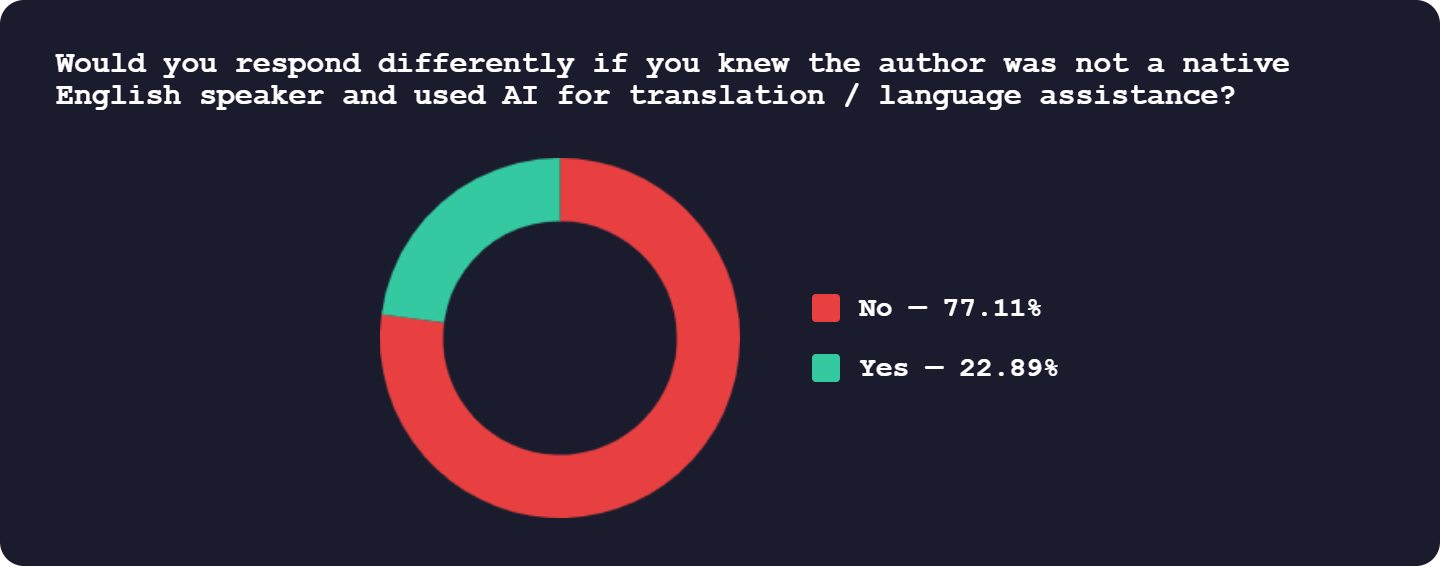
No, not much mercy here – only 23% would respond differently. Still, if you are using AI/LLMs for this purpose, you might want to disclose that prominently in your article. It could keep a fraction of readers from instantly dismissing it as pure AI slop.
The final question asked if readers would rather read the author’s authentic words – even with some awkward phrasing, grammar gaffes, and other nits. Or, do they prefer an LLM-polished version?
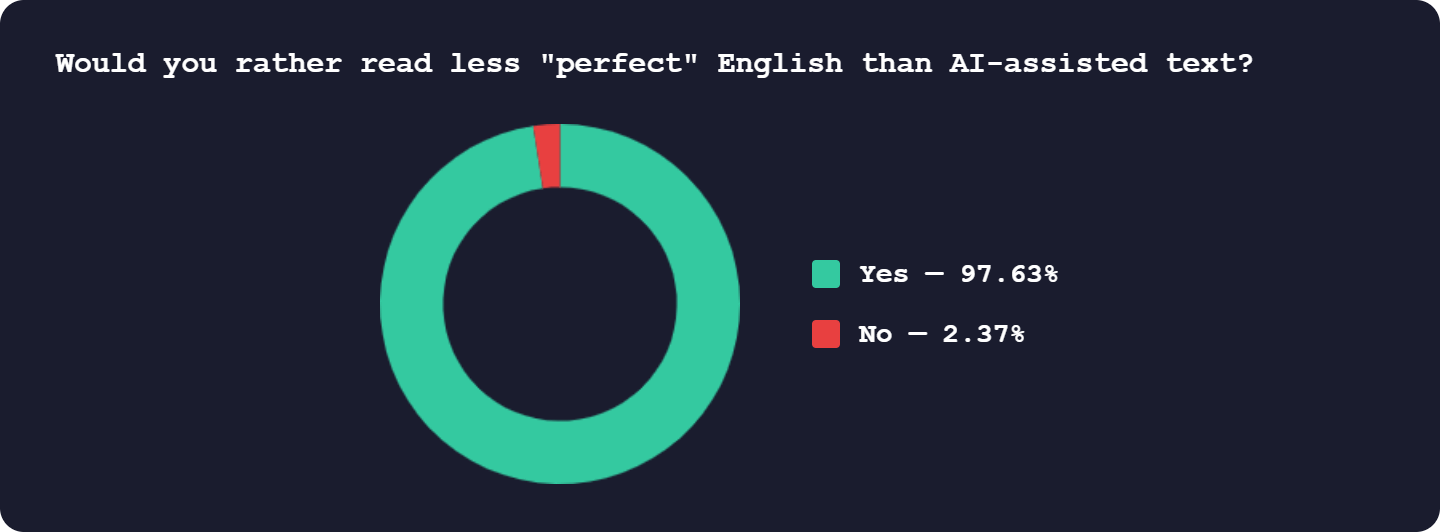
98% preferred the author’s own writing, as is. So writers, please – don’t let LLMs blandify your text. People would rather hear your authentic voice than suffer through an eerily soulless rewrite.
Could you create a Claude Skill to run a light editing round, revising awkward sentences in a way that approximates your actual voice with textbook grammar? With some work, maybe.2 Would a human editing your article be better or worse? Totally depends on the editor. And the success of both ultimately depends on how thoroughly you review every suggested change.
My unsolicited advice on the matter: focus on clarity over “perfection.” If you share interesting insights and your target reader can understand what you’re trying to communicate, some rough edges shouldn’t be an issue. A natural human voice is way more readable than perfectly predictable LLM prose. And – unless you’re opposed to using LLMs – let them help you improve your writing.3 Ask what sentences are unclear and why, propose your own revisions for it to review, use it to validate that your key points are coming across, etc.4
And now (some of) the comments
Let’s close with a sample of respondents’ commentary. In their own words…
On voice
“The most important thing that keeps me glued to a piece of writing is someone’s own voice. That’s just the human part of writing that makes it valuable. I don’t mind AI usage in writing and polishing in so far as there’s still a person I can hear.”
“I think blogs are fundamentally about who wrote it. I’m interested in the experience and communal aspect of it, not just content for its own sake.”
“Half the reason to read anything is to hear the author’s voice and to find authors you trust and appreciate for their work and nuanced style. AI flattens everything into nuance-free mush without character. I would rather read something imperfect and real written by a human than a ‘perfect’ (it’s never perfect) piece of text spit out by a bot.”
“If I am reading an article, I want to read about what the writer thinks, in their own words. Nuances in how they express themselves help me have a better understanding of who they are and where they are coming from. It makes it easier to connect.”
“It’s like autotune... people who can mostly sing get autotuned in movies and it destroys their performance for me... let them be imperfect or I lose connection, respect, trust... ...same goes for reading.”
“Trust *your* voice. Be happy with *your* identity. I understand this is hard, particularly if you’re younger, but push through the imposter syndrome or you’ll never get over it. An AI-pass just erases yourself from your own work. Burying your quirks and experiences beneath a mountain of generic niceties and bland socially-average “norms”.”
On trust
“Any hint of AI generated text makes everything in the article suspect because it means the person behind it probably lacks the subject matter expertise to flag factual errors.”
“My issue with this kind of prose isn’t ‘perfection’ or the lack thereof, it’s that everything comes out sounding like LinkedIn Business Influencer nonsense, which is the exact opposite of real technical expertise. I instantly suspect that the writer is selling without knowing, or has nothing original to say.”
“How can you trust the opinion of anyone on technology in particular if they outsource their thinking to an algorithm?”
“In practice, my most visceral and memorable responses are when it feels like I’ve been fooled – lied to. Where I expected expert knowledge or authentic opinion, I am instead hit with a grey molasses. The mean of all opinions. Uncontrasting.”
“When the writing is not authentic, how can I trust the content is authentic?”
On non-native English speakers
“As a non-native English speaker I really felt this. And I know how expensive translation can be all the while the world demands everything to be English to give it attention. But AI exaggerates the tone when it translates, and makes you lose the voice that you intend to convey in your work. Genuinely I’d rather read a badly translated work with the voice of the author than an AI-generated bland one that sounds like any twitter rando who just wanted clout.”
“The reason I notice something is AI generated usually has to do with the way that something has a very low insight to content ratio. I notice something being AI written more from things like it repeating the same pitch-y statements over and over in a different way, which is not beneficial to the reader. AI translation is unlikely to do the same thing if just taking what the person said and saying it in English.”
“Complicated. I saw an interaction play out on Reddit with this exact thing, where someone was using AI to interact with everyone, and people were getting SO mad. He said it was because he spoke in ‘broken English’ but everyone argued broken English is better than no soul at all.”
“I’ve worked with non-native speakers in my last job and there was a huge difference between how I perceived my colleagues when they sent me text that had been Google translated — which usually resulted in a sentence that had the ghost of sense, but needed some help to tease out the meaning — and text that had been prompted out of Claude or Gemini which was overly structured and while definitely easier to read, generally said nothing.”
On avoidance
“I’ve stopped reading a few newsletters and blogs because their authors keep ensloppifying the content. And that’s from established writers, who clearly have the skills, but don’t actually care about the craft. It bums me out.”
“If it’s a blog/news site I also blacklist it from web search results with the uBlacklist browser extension.”
“I will go out of my way to point out LLM use to people I know and recommend they avoid the author too.”
“Recently had a case where I could tell someone I follow’s latest blog post was AI-written. It’s awkward though because really I’d like to let the author know ‘hey, I can tell you wrote this using AI’ because genuinely I like their (non-AI) writing style normally... but that’s kind of a mean thing to say, so I just don’t say anything.”
“I personally almost immediately click away. I rarely, if ever, read through the post. And I do take note of the author, unsubscribe from their RSS feeds, and stop reading their content. This may sound drastic but if the author is using AI to write their posts they’re likely to continue doing it.”
“Raze it and salt the earth.”
Also, there were many comments expressing variations of “f**k AI.” You were heard.

Thanks to Phil Eaton for sharing that idea!
Some writers teach LLMs to write like them and are satisfied with the result. I think you can improve the voice simulation with guidance and guardrails, but I’m not a fan of outsourcing the creation of “your” articles. See this report for more on why others love/loathe writing tech blogs with LLMs.
Vincent Bernat just shared how he uses LLMs for review and surgical editing in Blogging with LLMs as a non-native speaker.
Shameless promo: There’s (much) more on that topic in the Writing for Developers book. Take a look if you’re interested in writing more compelling technical blogs.