

Simon Späti on Technical Blogging
“The way I write is with a curiosity in mind. I want to answer a question for myself, I don’t want to know the answer beforehand.”
Simon Späti’s web is one you’ll enjoy being caught in. You might enter via a blog post – likely on data engineering – then get hooked. You could easily spend hours exploring his neatly organized Second Brain, evergreen notes, and interactive graphs tying it all together.
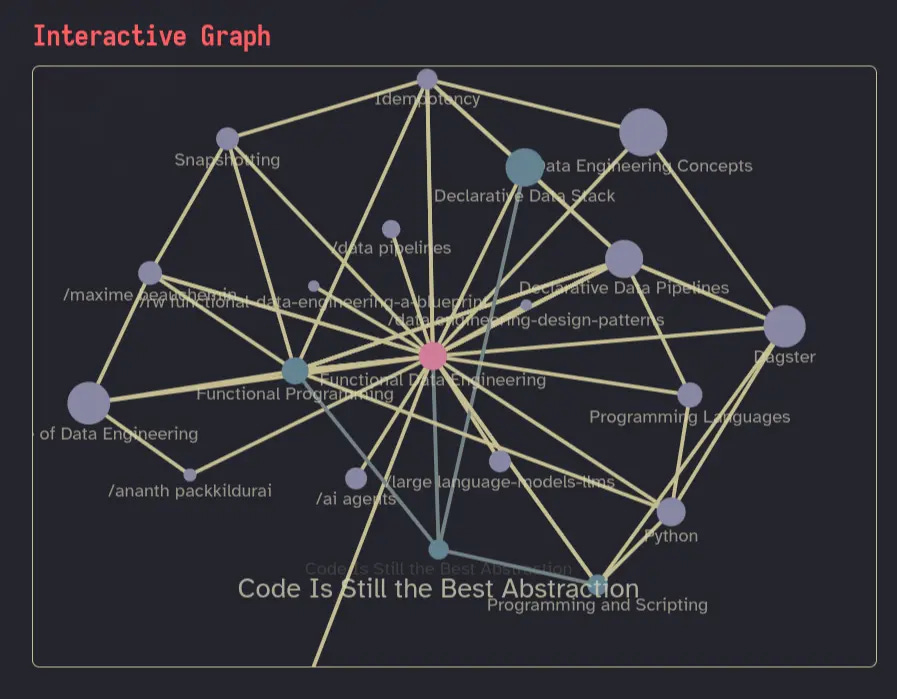
Simon has been creating, curating, connecting, and compounding content for over a decade now.
Let’s learn a bit about Simon’s blogging experiences and advice…
Why Did You Start Blogging – and Why Do You Continue?
I started as a hobby when I was living abroad in Copenhagen for three years, where in the beginning I didn’t know many people yet and was really impressed by the buildings in Denmark. So I made it a tradition to join the main library in Copenhagen every Friday after work, and write about something I liked.
The main starting point was that I was working with closed-source Microsoft software, mostly SSIS and SSAS and others in the stack. And I was fascinated with open-source tooling and wanted to try them out. First I started sharing some scripts I used like generating partitions for SSAS and some productivity tools I use, but the serious start was then in 2017 when I was writing about data warehouse automation and later, my key breakthrough with writing about Data Engineering, the future of Data Warehousing? just when data engineering started to get popular.
I didn’t write often, but very long pieces. I wanted to process my own thoughts, bringing it together in a nice format that I liked and hopefully stayed valuable long-term.
Sometimes when I read back my articles today, I feel I achieved some of it, as I find most of it to be true still, except if you write about specific tools obviously that are no longer here or similar.
But it was also a trick of mine to choose the right tools that I wanted to bet on and are mostly still here today (e.g. I’m an early fan of Dagster, and Delta Lake, OLAP cubes ), all of these are still valuable to this day.
My Journey
I started my first blog in 2015 - but I was online and registered a domain in 2004. I bought the domain sspaeti.com where my first endeavor was web development with HTML, CSS and PHP. The classic Apache years (fun fact, I still deploy to apache server to this day, but it’s only static HTMLs today :)
From 2005-2014 I ran a local forum and party guide (this was before FB :) and then in 2015 my first data-related post. 2016-2018: Regular blogging on Business Intelligence and data topics. 2019 I started to focus more on open-source data engineering. 2021 I moved from WordPress to GoHugo and 2022 I added the second brain to my website which meant all my notes and blogs were powered by Markdown which led me to share much more as it took me no conversion or work to publish anymore. What I wrote, I could just publish as is on my second brain. To this day, I have ~9000 private notes and ~1000 public notes. And 81 blog posts and some chapters of an early book I’m writing in Markdown too :).
2023 I changed the domain to ssp.sh, as it’s shorter :)
What Has Been the Most Surprising Impact of Blogging for You?
I was surprised, as my articles and website focus on data engineering, that my most successful (in terms of views and virality) are topics about Obsidian, vim, and philosophy.
That was a surprise to me - but now I get it. These were also where I had something on my heart, something I poured many years into and put into a single writing. So I guess there’s a lot of value - or it’s just because it touches more people than niche data engineering.
But impact work-wise, it helped multiple times. I got higher salaries because I was considered known “world-wide” through my blog. People knew my writing, and typically tend to like you as you give the writing for free.
Later when I started my own company, I basically didn’t have to sell, as I am online for so long, they know my writing, my principles, and even my life, as I share all kinds of notes on my second brain.
What Blog Post Are You Most Proud of and Why?
There’s probably the data engineering and technical writing side, and then there are all the other notes and blogs about life.
If we talk about data engineering, I think The Rise of the Declarative Data Stack that I wrote for a client of mine, encompasses the concept of a data platform. So, I like it because it provides a solution to a very difficult problem I had for many years, how to consolidate multiple data engineering tools into one.
I wrote it in 2024, and I think it couldn’t be more accurate today with AI agents needing as much context about our data stack as possible.
On the life and productivity side, it’s probably the blog in 2022 about Personal Knowledge Management Workflow for a Deeper Life. I share this blog still today to many friends of mine. I like it because it not only talks about work or note taking, but it comes full cycle from note taking, to work to a more fulfilled life. Since then I wrote many follow ups, but it is probably the one I’m most proud of.
My longest article that I spent two years on, is more on the philosophical side, which took so much time to get over the line, which I think has impacted people probably most deeply (at least counting the email replies), is Why Are We Here on Earth?. I’m sure this is not everyone’s cup, but if it is, it might be worth a (long!! 13k words) read. Other blogs under Reflections is where I’m most vulnerable and sharing my life, which is probably always the hardest as a writer, but most often, also the most gratifying and rewarding, especially when hearing the genuine and honest feedback of people.
What Post Was the Most Difficult to Write and How Did You Tackle It?
Writing is always hard, but the hardest and least fun is always if someone tells me what to write about. This is hard, as I write best when I’m excited about the topics, to know more, to explore and share what I learned with the readers.
The way I write is with a curiosity in mind. I want to answer a question for myself, I don’t want to know the answer beforehand. I don’t know where I’m heading - so I don’t have an ultimate goal or topic in mind. I always set a title, and then go with the flow, see where it leads me, and these are the best writings of mine.
If I have to write about X in this outline, it couldn’t be more boring, and that is usually reflected in my writing. On the other hand what I also like, if I know the space very well, and I know all the answers per se, I can write a leadership thought piece, bringing together 20 years into one blog. That challenge is also one I enjoy, even though I know most of the topic, but there I have the challenge of really nailing the storytelling to talk about twenty years but in a coherent way, that makes sense from start to end.
This boils down to the art of leaving things out, which I am getting much better over time and I think is really what storytelling is all about.
Any Lessons Learned that You Want to Share with the Community?
Yes, write about topics you are passionate about, things you are curious about. And write from the heart, and gut.
Don’t be shy to wait and sleep over it, don’t force it (take all the time needed). How many times have I tried to force it, only to go to bed early, and the next day wake up and just have it flow out of my fingers.
Usually, when you let it flow, the article is written in one go, which means the reading flow is much better compared to tackle it often. The stop and go might not make a coherent story, or at least it’s harder to achieve.
I differentiate between the early stage where I add sentences, notes, lots of listing, linking to existing notes in my second brain/Obsidian vault. It’s the idea creation phase. Later when I finish it, I have to write it in one go.
That’s why when I get feedback from people, I like to get that before I do that last run. Because if I go through it, re-write it, and make it coherent, AND then get feedback, this might break the whole flow again, and it’s hard to repair. Or means you start over.
It’s also what the likes of Jason Fried and others say, writing is rewriting. Which is something I started to believe more and more in. If you re-write, each time it gets better. Your gut, your subconscious has worked on it while you slept or showered or did other things. If you sit down, and write it again from scratch, you might forget things (mostly less important) and focus on the storyline with the most important things for you at that moment, which defines also the storyline!
There’s So Much More: Vim Motions, Rhythms, Breaks
There’s so much more that I learned and that is relevant, but I don’t have time to explain all and don’t want to bore your readers, so here are just some links that I think are key when writing too and I learned slowly over the years:
Take breaks: Coffee Break Rhythm.
Starting is hard, remind yourself of the Ultradian Rhythm: The first 10 minutes of a 90-minute (Ultradian Rhythm) deep work block are always going to be hard. That’s okay.
If you’re planning on writing (or also programming) eight hours a day, as you’ve probably invested some time to touch-type, invest some more time into Vim Motions - not vim the editor, but the motions behind. You might enjoy my write-up on Why Vim Is More than Just an Editor (there’s much more, but this is a good one to start with).
Writing is an artwork, a form of releasing your creativity. The hardest part is to find your voice, and this only happens when writing, and more importantly, when writing in public. Keep writing, until you find your voice, from there on, it will be much easier.
A nice lifehack for writers, write within the publishing app. What do I mean by that? Sometimes it’s hard to write in your notes app, or offline, but if you send an email to a friend, or write in a LinkedIn post or in your blog editor, the pressure is on. You know it’s going to go live, or it’s for a certain friend. This can help you unblock writers block or also just produce better quality as you know it’s going online. Doesn’t work always, but it’s a great hack sometimes.
Your Advice for People Just Getting Started with Blogging?
Just start journaling and taking notes. This will help you improve your writing. And you will have lots of ideas and strains to pull from when you start publishing. The best advice to me to get started was to Learn in Public. Think of it as you note down your learnings; don’t think I need to write a masterpiece. Because if you just write it for yourself, you’ll publish much earlier, since it’s mostly for you to remember. But as always, if it’s helpful to you, others might find it too. AND you get a feedback loop that tells you which blogs/notes are more interesting to people and which aren’t (not that you need to follow that, but it helps).
From the “technical” side, start with a Static Site Generators (SSG). They are easy, super fast for the reader, and you can write in plain Markdown. If you don’t know it, learn it; it’s super simple. Use Obsidian as an editor, and you won’t even notice that it’s Markdown under the hood.
Buy a domain. I don’t like if you start with Medium, Substack, or WordPress domains, and then when you switch, you lose all your credibility, worst case, even your old writings. No matter what tools you use, no hard feeling if you start with Substack or similar, but buy a domain and link it to it. Because over time, your domain will get authority, and grow and compound over time - which to me is the most powerful thing you can get from writing. Usually one blog or article doesn’t make it, but the total set of articles, when people come back to you.
Also services and tools can go away, your domain hopefully stays. Also, don’t overthink when you start, as with everything new, the first blogs, not many are going to read anyways. Be prepared for that.
I also find the distinction important between a Newsletter and a blog. Newsletter gets sent to people’s emails, so you should always have a link to where people can sign up to your email list. But this is not the same as Substack or a blog. When I started, there was Mailchimp where you’d send a newsletter, which is your direct communication with the reader, inform them about new blogs, or notes, things you encountered during your last time. It is a 1:1 direct communication.
A blog on the other hand, is something different. You write about certain topics, you distill a topic into a nice flow of words and article. Totally different. So try to be very clear about this, especially if you start a Substack, which is a mix of both, to not confuse these.
Probably the easiest way to get started, just an email converted to a blog
As with the mentioned unblocking above, if you are the type that has a hard time getting started, also know that Hey World has this feature integrated into their email, so you can write an email as you would normally, just a different recipient, and if sent, it will be online as a normal blog post. So if you want to get started, this can help you in a very easy way.
A Few Blogs that You Particularly Enjoy?
All my RSS feeds are public at urls-categories.opml (and also on RSS Feeds), so you can see what I read, not only data engineering and others.
Probably my ultimate favorite writer is Derek Sivers. His minimalistic approach to writing, also how he shares his books, content online, is very fascinating to me. I always learn a ton from his writings and also podcasts, he truly is an inspiration to me.
On the data engineering side, Maxime Beauchemin was one of the icons that inspired me to write more. I loved his writings about defining data engineering, though he writes less these days. I also enjoy Jason Fried’s blogs on writing and general advice in business.
Not a blog, but a book that helped me a ton, which I also wrote about finding mine, is The Pathless Path by Paul Millerd. This is the Tim Ferriss 4-Hour Workweek book, updated for today, and it inspired me to take the step of going full-time as a freelance technical writer and making writing my job.
***
Extra: For an even deeper dive into Simon’s thoughts on writing, see Why I Still Blog on his site.
